









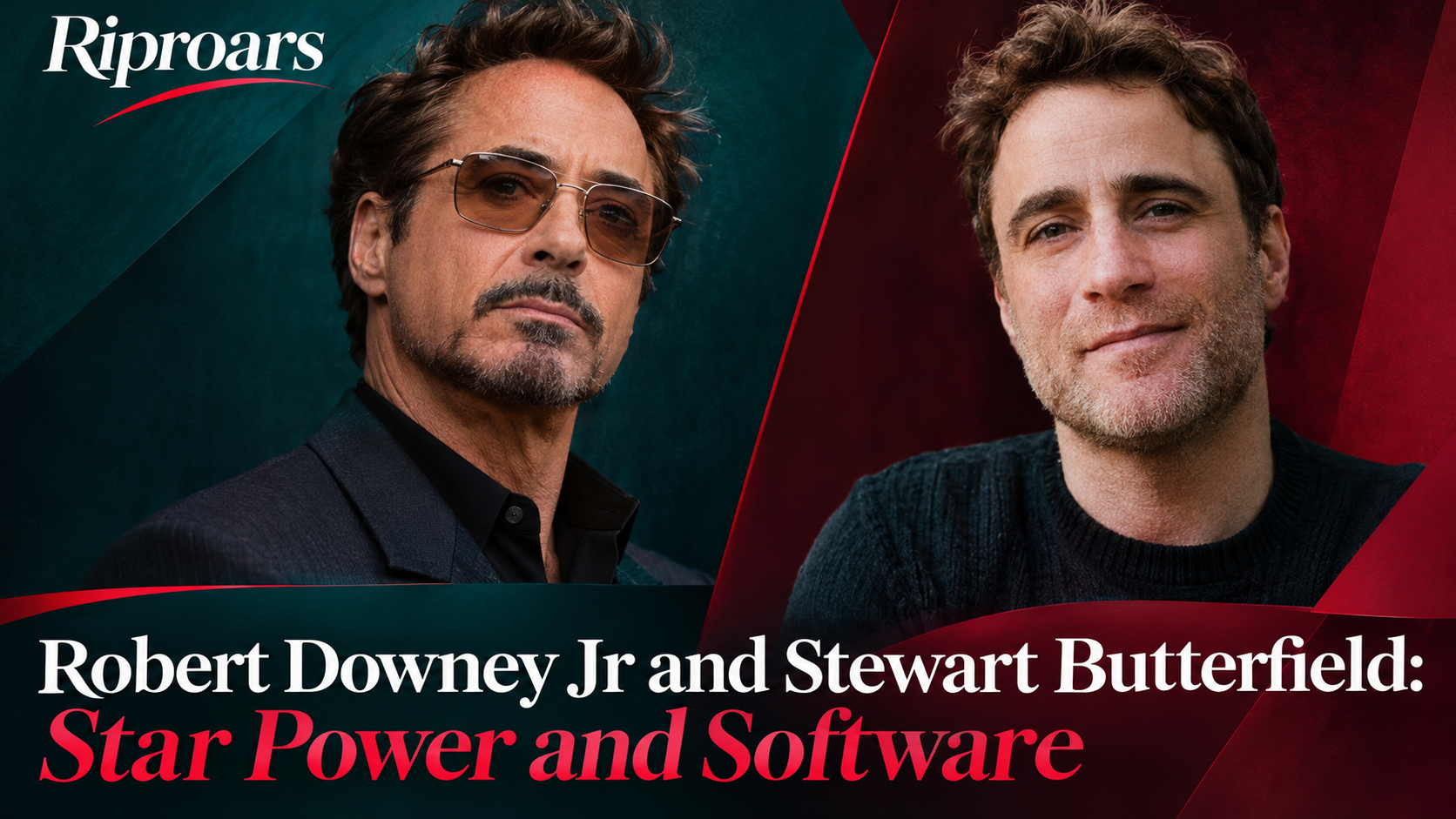
Robert Downey Jr and Stewart Butterfield are associated with different kinds of widely used cultural and commercial products: Downey with film performance, and Butterfield with the workplace software business Slack. The sources reviewed do not establish a joint project between them. Their comparison is useful for understanding how a recognisable individual contributes to work that depends on a much larger team.
A film star and a software founder can both become the public face of a project. Yet a performance, a company and a person’s private finances remain separate subjects. The clearest account begins with verified achievements, explains the systems behind them and avoids converting a production’s or company’s headline value into personal wealth.
Robert Downey Jr and Stewart Butterfield: two verified milestones
The Academy’s 2024 ceremony record identifies Downey as the supporting-actor winner for Oppenheimer. This is a specific acting achievement attached to a particular film. It is stronger evidence than an unsourced description of a performer as universally acclaimed.
For Butterfield, a useful corporate milestone is Salesforce’s completion of its Slack acquisition in July 2021. The announcement identifies Butterfield as Slack’s co-founder and CEO at that time. A dated historical title should not be copied as proof that he holds the same position now.
These milestones belong to different categories. The Oscar records recognition by an awards institution; the acquisition records a corporate transaction. Both matter to a career profile, but one cannot be used as a unit for measuring the other. A useful comparison explains their significance within their own fields.
What the audience sees in a performance
An actor’s contribution is visible and audible in the finished film. Viewers can assess choices of expression, timing and interaction with other performers. The performance is nevertheless shaped by the script, direction, editing and the wider production. The actor’s work is individual without being independent of everyone else’s.
This is why an acting award should be described precisely. Winning in a supporting category does not mean the person received a directing or writing award, and it does not reveal the terms of their employment. A career profile can celebrate the achievement without adding unsupported claims about creative control or compensation.
It also helps to distinguish the performer from the role. A character’s actions and views belong to the dramatic work. They should not automatically be attributed to the actor personally. Criticism can analyse the effect of a portrayal while reporting about the individual requires a separate factual basis.
What users experience in workplace software
A workplace service is encountered through repeated use rather than a single screening. Users need to communicate, locate information and fit the service into their organisation’s practices. The interface matters, but so do reliability, administration and support. A useful product has to work within the customer’s daily routine.
A founder’s public explanation can make the product’s purpose understandable. It cannot replace the actual experience of using it. Customer requirements, team practices and organisational policies can differ, so popularity does not mean every workplace will use a service in the same way. The product should be assessed against the relevant task and context.
Software also involves continuing development. Features, integrations and administrative options can change after launch. A historical founder profile is therefore not a substitute for current product documentation. Claims about what a service can do today need current evidence from the service itself or appropriate testing, rather than assumptions based on its original story.
Founding, ownership and executive work are different
Founding a company is a historical relationship that can remain true after the person leaves daily management. Ownership concerns a financial interest, while an executive role concerns authority and responsibility within the organisation. These relationships can overlap, but they should never be treated as interchangeable.
The distinction is especially important after an acquisition. A business can become part of a larger group while retaining its product identity. The transaction has legal and financial terms, and later leadership arrangements can change. Readers should use the relevant dated records for each stage rather than assuming the founding team remains in charge indefinitely.
Similarly, an actor’s association with a successful film series does not mean the actor owns the production company or the underlying rights. Contracts can assign different rights and rewards to different participants. A recognisable face or founder’s name can make a complicated arrangement easier to remember without explaining the arrangement itself.
Teams turn a public promise into a finished experience
Film and software both depend on collaboration, although the work is organised differently. A film production brings together creative and technical specialists to produce a released work. A software company maintains and develops a service that users may rely on repeatedly. In each setting, the public face is part of a larger system.
That observation helps avoid exaggerated attribution. A star can make a substantial contribution without being the sole cause of a film’s success. A founder can shape a product without personally creating every feature. A balanced account identifies the individual’s contribution and the institution through which it reached the audience or customer.
Why corporate transactions do not equal personal fortunes
An acquisition value describes a transaction involving a business under particular terms. It is not automatically a cash payment to one founder. Other shareholders, different classes of interests and contractual arrangements can all matter. An individual’s proceeds would require evidence about their own holdings and the transaction’s treatment of them.
The same caution applies to films. Ticket revenue does not equal an actor’s salary, and a reported salary does not equal net worth. Personal wealth includes assets and liabilities beyond one project. This article therefore avoids a precise financial ranking between Downey and Butterfield and focuses on the professional records that can be established.
How to assess a mixed entertainment-and-technology story
Ask whether the article has identified an actual relationship or is simply making a comparison. Both can be legitimate, but they require different wording. A shared venture needs direct evidence. An analytical comparison should explain its purpose and avoid presenting separate portraits as a photograph of a shared event.
Then check whether the sources match the claims. An Academy record can verify an award; a company announcement can verify a completed acquisition. Neither automatically verifies a private friendship or a net-worth estimate. The reader should be able to trace each important fact to evidence that directly supports it.
Riproars’ Revealspro.com overview and Hoodyvan.com guide provide related reading about evaluating online information. They are not evidence of any involvement by Downey, Butterfield, Slack or Salesforce.
Time is another useful distinction. A viewer can revisit a film after release and judge the same completed work differently. A software user may return to a service that has itself changed through updates. Reviews should explain which version or period they address. This prevents a statement about an old product experience from being presented as a current technical claim, while also helping readers understand why a historical founder story cannot answer every question about the service’s present operation or suitability for a particular workplace.
Frequently asked questions
Have Robert Downey Jr and Stewart Butterfield collaborated?
The sources reviewed do not establish a shared project. Their careers are compared through separate documented achievements.
Which Oscar did Downey win in 2024?
He won the supporting-actor award for Oppenheimer, according to the Academy’s official ceremony record.
When did Salesforce complete its Slack acquisition?
Salesforce announced completion in July 2021. Its announcement records the corporate event and identifies Butterfield’s role at that time.
Does being a founder mean someone is still CEO?
No. Founding is a historical relationship; an executive appointment can change. Current roles need their own verification.
Does a company’s sale price establish its founder’s wealth?
No. Ownership, transaction terms, taxes and liabilities matter. A business’s value is not automatically one person’s personal fortune.

One thought on “Robert Downey Jr and Stewart Butterfield: Star Power and Software”